


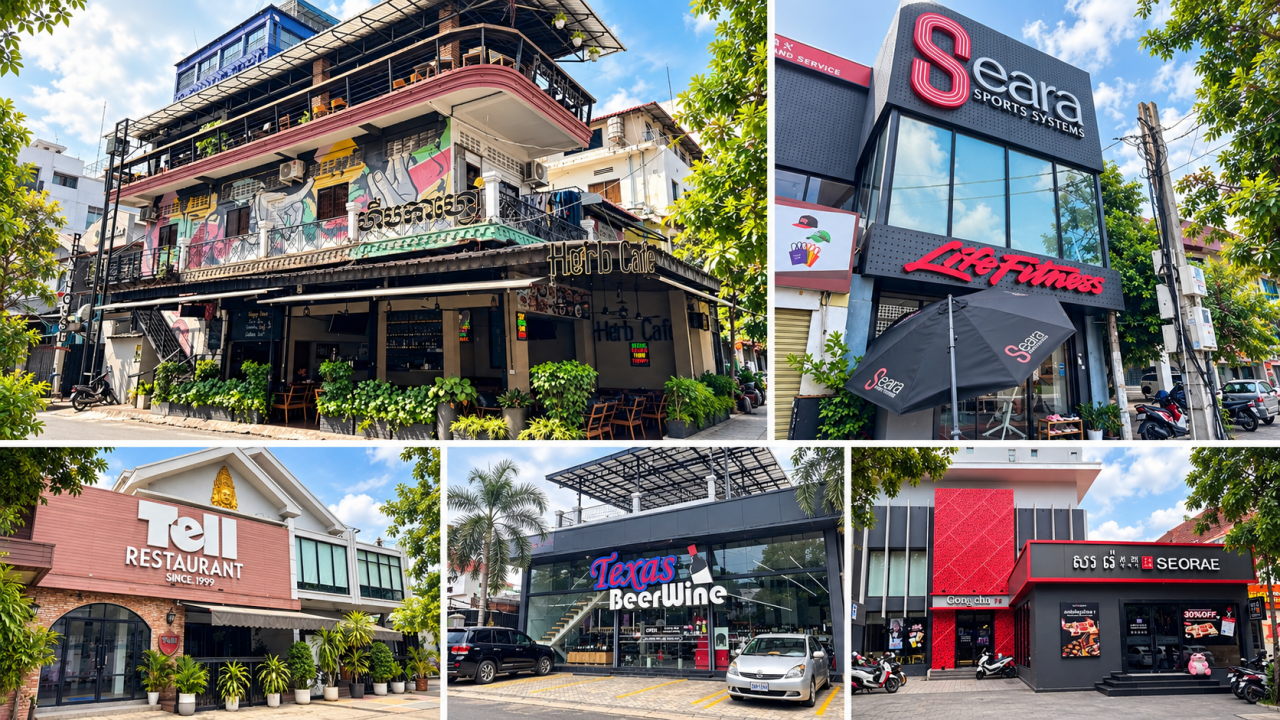
From restaurants and catering to trade, tourism and digital services: five business sectors worth exploring for foreign entrepreneurs in 2026.
When people think about investing in Cambodia, real estate is often the first thing that comes to mind: buying a condominium, renting out an apartment or managing property.
But Cambodia offers opportunities beyond real estate.
Restaurants and coffee shops are opening, trading companies are developing, and entrepreneurs are exploring tourism, digital services and businesses focused on everyday needs.
One of Cambodia's most important advantages for foreign entrepreneurs is that companies can be 100% foreign-owned in many sectors, without requiring a Cambodian shareholder.
In neighbouring Thailand, foreign ownership and business operations face additional restrictions in certain industries. Some activities require special permission or compliance with limits on foreign participation.
↓ Try our free Business Launch Risk Calculator
Cambodia offers a more open framework in many sectors, although exceptions and industry-specific requirements apply. Land ownership is also regulated separately.
Important: The right to own a company does not remove obligations relating to business registration, taxes, licences and labour regulations.
So which business opportunities are worth considering?
In this guide, we explore five sectors beyond real estate, explain their characteristics and highlight the main risks.
You can also use the free interactive Business Launch Risk Calculator in Phnom Penh — 2026, developed by Qunera Services, to compare business sectors, assess your planned investment, set a launch timeline and explore potential financial risks.
Why Look Beyond Real Estate in Cambodia?
Real estate remains a visible part of Cambodia's investment market, but it is far from the only opportunity.
Some entrepreneurs want to build companies where they can apply their professional experience. Others hope to develop products or services for local customers, international residents or businesses.
According to Cambodia's official online business registration statistics, restaurants and mobile food service activities rank among the most frequently selected business activities.
Wholesale and specialised retail activities are also prominent in the registration data.
However, these figures cover business registrations in general, not exclusively companies established by expatriates.
Furthermore, a high number of business registrations does not mean that a sector is particularly profitable. A popular market may be highly competitive, while a less visible niche may offer opportunities to an entrepreneur with the right experience.
Let's look at five possibilities.
1. Gastronomy — Restaurants, Cafés, Bars & Catering
Gastronomy is one of the most visible business sectors within Phnom Penh's international community.
The city offers small coffee shops, European restaurants, bakeries, bars and independent dining concepts.
For a foreign entrepreneur with experience in hospitality or food service, opening a business in this sector may provide an opportunity to apply existing skills in a new market.
Importantly, a food business does not necessarily need a traditional dining room.
Which Business Models Are Worth Exploring?
Café or bakery. A small establishment offering a focused selection of products. Its performance depends heavily on location, product quality and repeat customers.
International restaurant. A dining concept designed to attract international residents, tourists and Cambodian customers.
Bar or evening venue. A format where location, atmosphere, staff management, safety and relevant operating permissions are especially important.
Takeaway & delivery-only kitchen. A business focused on preparing food for collection or delivery, potentially without a full dining area. This may reduce some interior and front-of-house costs, but places greater importance on kitchen efficiency, packaging, delivery logistics and marketing.
Catering. Food preparation and delivery for corporate meetings, private celebrations and other events. Organisation, transport, staffing and meeting agreed deadlines are essential.
Each business model requires its own approach to premises, daily operations and financial planning.
Who is it suitable for? Entrepreneurs with food-service experience who are prepared to manage product quality, employees and everyday operations.
Main risk: High fixed costs, competition and dependence on a consistent flow of customers or orders.
Our conclusion: Gastronomy offers several business models, from a small delivery kitchen to a full-service restaurant. Success depends on matching the concept to real customer demand and managing the business effectively.
2. Import, Export & Specialty Retail — Trade and Distribution
Trade is another important area of business activity in Cambodia.
Foreign entrepreneurs may consider importing specialised products, supplying equipment, serving business customers or opening niche retail stores.
Potential examples include equipment for restaurants and hotels, professional supplies, specialty food products and other goods with identifiable demand.
Entrepreneurs who already have reliable suppliers, international trading experience or established customers may be able to use these advantages when developing a business in Cambodia.
Unlike a restaurant, a trading company does not always depend on attracting large numbers of walk-in customers every day.
However, importing and distributing goods requires attention to customs procedures, product-specific requirements, storage, delivery and after-sales support.
Inventory management is particularly important. When products sell slowly, a substantial amount of working capital may remain tied up in stock.
Who is it suitable for? Entrepreneurs experienced in trade, procurement and international logistics.
Main risk: Supplier dependence, customs-related difficulties and capital tied up in inventory.
Our conclusion: Trade and distribution may offer attractive opportunities when customer demand is established and supply chains are well organised.
3. Tourism & Hospitality
Cambodia is internationally known for Angkor Wat, its historical attractions, natural landscapes and varied travel destinations.
However, tourism-related business is not limited to large hotels and organised sightseeing tours.
Foreign entrepreneurs may explore small guesthouses, specialised tourism services or businesses supporting existing hotels and travel operators.
Which Opportunities Are Available?
Small guesthouse or boutique hotel. A business designed to offer a distinctive atmosphere and personalised guest experience. Its prospects depend on location, service standards and room occupancy.
Niche tourism services. Themed experiences, culinary tours, personalised travel programmes and other specialised services for defined customer groups. Licensing requirements and restrictions on certain activities must be checked before launch.
Services for the hospitality industry. Marketing, booking systems, technical support and other services for established hotels and tourism businesses.
Location matters. Phnom Penh, Siem Reap and Kampot attract different types of visitors, and demand can vary throughout the year.
Who is it suitable for? Entrepreneurs experienced in tourism, hospitality and customer service.
Main risk: Seasonality, competition and dependence on visitor demand.
Our conclusion: The tourism sector offers opportunities ranging from small guesthouses to specialised service companies. Each business should be assessed against its specific location and target audience.
4. Professional & Digital Services
Not every business requires extensive premises, expensive renovations or physical inventory.
For professionals experienced in IT, marketing, design, web development or other specialised services, Cambodia may offer a base from which to establish and grow a company.
Such businesses can serve customers within Cambodia and internationally.
What Services Could You Offer?
-
Web development and software. Website creation, application development and technical support.
-
Digital marketing and SEO. Online promotion, advertising management and search engine optimisation.
-
Design and content creation. Graphic design, branding, photography and video production.
-
Business process automation. Digital tools and systems that help companies improve operational efficiency.
-
B2B consulting. Specialised advisory services in areas where the entrepreneur has relevant professional knowledge and experience.
Regulated professions may require specific licences or qualifications.
The main assets of these businesses are professional expertise, reputation and customer relationships.
In some cases, the initial investment can be substantially lower than the cost of opening a restaurant or physical retail store. However, professional skills alone do not guarantee a steady flow of clients.
Marketing, customer acquisition and long-term business relationships remain essential.
Who is it suitable for? Skilled professionals with relevant experience and a clear understanding of how to attract customers.
Main risk: Insufficient demand and dependence on a small number of major clients.
Our conclusion: For an entrepreneur with established professional expertise and customer experience, a digital or consulting business may be a more accessible first venture than a restaurant or shop.
5. Lifestyle & Wellness Services
Our fifth category covers services focused on health, comfort and everyday quality of life.
Foreign entrepreneurs may explore small fitness studios, yoga classes, personal training, wellness concepts and specialised household services.
Potential customers include both international residents and Cambodian consumers.
Which Business Models Are Worth Considering?
Fitness studio or personal training. A small gym, group exercise studio or individual training programmes. Performance depends on location, qualified trainers and the ability to develop a loyal client base.
Yoga & wellness studio. Yoga classes, relaxation programmes and other services related to physical and emotional wellbeing. Certain activities may be subject to specific qualification or licensing requirements.
Specialised household services. Services that address recurring needs among city residents, such as organised cleaning, laundry services or other forms of regular assistance.
An advantage of some of these business models is the potential to generate repeat business from regular customers.
Nevertheless, it is important to identify the target audience and verify actual demand. A service popular among expatriates may not necessarily appeal to local residents, and vice versa.
Premises, equipment and staffing costs can also be significant, even for relatively small operations.
Who is it suitable for? Entrepreneurs with relevant experience who can deliver consistent service quality and develop long-term customer relationships.
Main risk: Overestimating demand, high fixed costs and difficulties attracting or retaining customers.
Our conclusion: Lifestyle and wellness services can provide an alternative to traditional business models, particularly for entrepreneurs with specialised experience and a clear understanding of their customers.
Business Launch Risk Calculator in Phnom Penh — 2026
Are you considering opening a restaurant, trading company or another business in Cambodia, but unsure whether your budget is sufficient or your launch schedule is realistic?
Qunera Services has developed a free interactive calculator to help you make an initial assessment of the financial, market and operational risks associated with your business idea.
How to Use the Calculator
1. Select your business sector.
Choose from five options:
-
Gastronomy — restaurants, cafés, food delivery and catering.
-
Import & Trade — importing, trading and distribution.
-
Tourism & Hospitality — tourism and accommodation services.
-
Professional & Digital — consulting, technology and digital services.
-
Lifestyle & Wellness — fitness, wellness and everyday services.
Each sector has its own illustrative starting assumptions.
2. Enter your planned investment.
Move the slider or enter an amount manually. The calculator compares your budget with the estimated capital requirements of the selected business model, including a financial reserve.
3. Choose your launch timeline.
Specify when you would like to begin operating, from one to six months. The calculator assesses how your chosen timeline compares with its assumptions for that sector.
4. Enter your estimated monthly operating costs.
Consider expenses such as rent, salaries, utilities, supplies and other recurring costs after launch.
What Will the Results Show?
The calculator generates a risk score from 0 to 100, accompanied by a colour-coded indicator:
-
🟢 Green: The proposed launch plan appears relatively well prepared.
-
🟡 Yellow: Certain constraints require further attention.
-
🔴 Red: Important assumptions should be reconsidered before proceeding.
The assessment combines four categories: Finance (50%), Timeline (25%), Market (15%) and Operations (10%).
You will also receive specific warnings, such as a potential budget shortfall, an estimate of how long your remaining funds could cover operating costs and common challenges associated with your selected sector.
Three Business Scenarios
Rather than relying on a single outcome, the calculator compares three illustrative scenarios.
Optimistic. Preparation and launch proceed under relatively favourable conditions.
Realistic. The baseline scenario used for the main risk assessment.
Pessimistic. Costs increase by 20%, and revenue begins two months later than originally expected.
An interactive chart also demonstrates how the calculated risk changes as the initial investment increases or decreases.
Save Your Report or Speak with Qunera Services
After completing the assessment, you can save your results as a PDF and use the report as a starting point for further planning.
If you would like to discuss establishing a company in Cambodia, use the calculator's WhatsApp Qunera Services button to request a consultation.
Choose a business sector and explore your potential launch risks below.
Important: This calculator is intended for preliminary business planning. Its figures, scenarios and risk scores are based on an illustrative model rather than statistically validated predictions of business success. Results do not guarantee profitability or constitute personalised investment advice.
What Should You Do Before Starting a Business in Cambodia?
Choosing a promising sector is only the beginning. Before committing funds, it is important to assess not just the cost of company registration but the entire process from business idea to actual operations.
Identify your target customers. Will you serve Cambodian residents, expatriates, tourists or other businesses? Understanding your audience will help determine your business model, location and pricing.
Calculate your budget and financial reserve. In addition to initial investment, allow for rent, deposits, equipment, staff, marketing and ongoing expenses. Maintaining adequate funds while revenue is still developing is particularly important.
Check the requirements for your business activity. Although Cambodia permits 100% foreign ownership in many sectors, certain industries require additional licences, permits or compliance with specific regulations.
Assess premises and location. For restaurants, shops and fitness studios, the right location may be critical. Before signing a long-term lease, examine the property's condition, permitted use and suitability for the intended business.
Plan your operations. Who will manage employees, purchasing, customer service and financial controls? Even a small business needs clearly defined responsibilities.
Clarify residence and work requirements. Company registration, permission to work and immigration status are separate matters that must be considered individually.
Good preparation cannot eliminate every business risk, but it can help prevent costly decisions made too quickly.
Our advice: Before signing agreements or making substantial investments, develop a realistic launch plan and test its main assumptions. The free Qunera Business Launch Risk Calculator above can help you begin that process.

Business Launch Risk Calculator in Phnom Penh — 2026
Explore five business sectors, set your budget and timeline, and see financial readiness, three planning scenarios and practical next steps.
◈ Choose your business sector
Rent, salaries, utilities, marketing and other recurring expenses.
How the assessment works
Illustrative risk score (0–100): financing 50%, launch time 25%, market exposure 15% and operational complexity 10%. Each sector uses editable editorial assumptions, not verified market averages. A score is not the probability of failure.
Base capital requirement = reference setup amount × 1.2, plus three months of operating expenses. The model assumes no operating revenue during that period. This is a deliberately cautious screening model, not a cash-flow forecast.
✦ Overall planning risk
Risk breakdown
◎ Gaps & recommended actions
▥ Three scenarios
⌁ How risk changes with investment
Horizontal: starting budget · Vertical: overall planning risk. The dot marks your selection. The graph uses the same simplified scoring model.
⚑ Common reasons businesses struggle in this sector
Planning to launch a business in Cambodia?
Discuss your business setup plans with Qunera Services in Phnom Penh. Save your assessment as a PDF or send a concise summary through WhatsApp.
Educational planning tool only. Estimates and sector assumptions are illustrative, not verified local averages or investment advice. Scores do not predict business success, investment returns, processing times or regulatory approval. Confirm actual quotes, licences, taxes, staffing and legal requirements before committing funds.
How Qunera Services Can Help with Business Setup in Cambodia
Starting a company in another country involves more than business registration and obtaining official documents.
Entrepreneurs must understand local procedures, organise practical arrangements and coordinate with local suppliers and service providers.
Qunera Services is based in Phnom Penh and helps foreign entrepreneurs organise their business setup and initial operations in Cambodia.
Depending on the project, our practical support may include:
-
Business Setup. Organisational assistance with company registration and coordination of necessary procedures.
-
Commercial Property Search. Assistance with finding and inspecting suitable offices, shops, restaurant premises and other commercial spaces.
-
Local Coordination. Support in communicating with suppliers, service providers and other parties involved in the project.
-
Specialist Services. Coordination with qualified legal, tax and other professionals when specialist advice is required.
-
Relocation Support. Practical assistance with moving to Cambodia and organising everyday life during the initial stage.
Our aim is to help you understand local conditions and organise the practical steps needed to move your project forward.
Planning to Start a Company in Cambodia?
Whether you have already selected your business sector or are still exploring possible opportunities, contact Qunera Services to discuss your plans.
You can also use the Business Launch Risk Calculator above, save your results as a PDF and use the report as a starting point for our conversation.
Telegram — Business Setup: https://t.me/QuneraBusinessSetup
WhatsApp: https://wa.me/855767776732
Website: https://qunera.online
Qunera Services provides practical and organisational support. Where necessary, legal, tax or investment assessments should be carried out by appropriately qualified professionals.
Frequently Asked Questions (FAQ)
Can a foreigner start a company in Cambodia without a local partner?
Yes. Cambodia allows 100% foreign ownership in many business sectors, meaning a foreign entrepreneur can own a company without a mandatory Cambodian shareholder.
However, specific activities may be subject to restrictions or additional requirements. Land ownership is regulated separately.
How is starting a business in Cambodia different from Thailand?
Cambodia permits 100% foreign ownership across many business activities.
In Thailand, certain activities fall under restrictions in the Foreign Business Act, meaning foreign investors may need specific permissions or a legally permitted ownership structure.
The options depend on the industry and applicable regulations.
Which businesses are most popular among foreigners in Cambodia?
Restaurants, cafés, trading companies and service businesses are visible within Cambodia's international business community.
However, available official data does not establish a reliable ranking of business types specifically owned by expatriates.
Restaurant activities feature prominently in Cambodia's overall online business registration statistics.
What business can I start in Cambodia with a relatively small budget?
Professional and digital service companies may sometimes require less initial capital than restaurants, shops or hotels.
Actual costs depend on the business model, licences, staffing, premises and customer acquisition expenses.
How long does it take to start a business in Cambodia?
There is no single timeline that applies to every project.
Preparation depends on company registration, necessary permits, premises, equipment, employees and other practical requirements.
For example, launching a small digital services company can be very different from opening a restaurant or hospitality business.
What does the Qunera Business Launch Risk Calculator measure?
The free interactive calculator allows you to select one of five sectors and enter your planned investment, launch timeline and estimated monthly expenses.
Using an illustrative calculation model, it assesses finance, timeline, market and operational factors.
Results include a 0–100 risk score, three business scenarios, a budget-risk chart and practical recommendations.
The calculator provides a preliminary assessment, not a prediction of profitability or the likelihood of business success.
Can I save my calculator results?
Yes. You can save your results as a PDF to support further business planning or discussions with Qunera Services.
Does a foreign company owner need a work permit in Cambodia?
Owning a company and personally working in Cambodia are different matters.
Foreign entrepreneurs who actively work in Cambodia should verify the applicable immigration and work permit requirements.
Can Qunera Services help me establish a business in Cambodia?
Yes. Qunera Services provides practical and organisational support with Business Setup, coordination of relevant procedures, communication with local service providers and related arrangements.
You can contact us through Telegram Business Setup or WhatsApp.
Sources and Further Information
Ministry of Economy and Finance — Online Business Registration
https://registrationservices.gov.kh/home-en/
Ministry of Economy and Finance — Doing Business in Cambodia
https://ppp.mef.gov.kh/investors-corner/doing-business-in-cambodia
KhmerSME — Make Your Business Legal
https://www.khmersme.gov.kh/en/starting-a-business/make-your-business-legal/
Cambodian Investment Board — Investing in Cambodia
Thailand Government — Foreign Business Act and Foreign Ownership
https://www.thailand.go.th/public/issue-focus-detail/006-015
Last updated: October 2026.
Disclaimer: This article is intended for general information only and does not constitute personalised investment, legal or tax advice. Illustrative estimates do not guarantee profitability or sufficient capital. Before investing, review the specific business model, applicable regulations and financial obligations.