


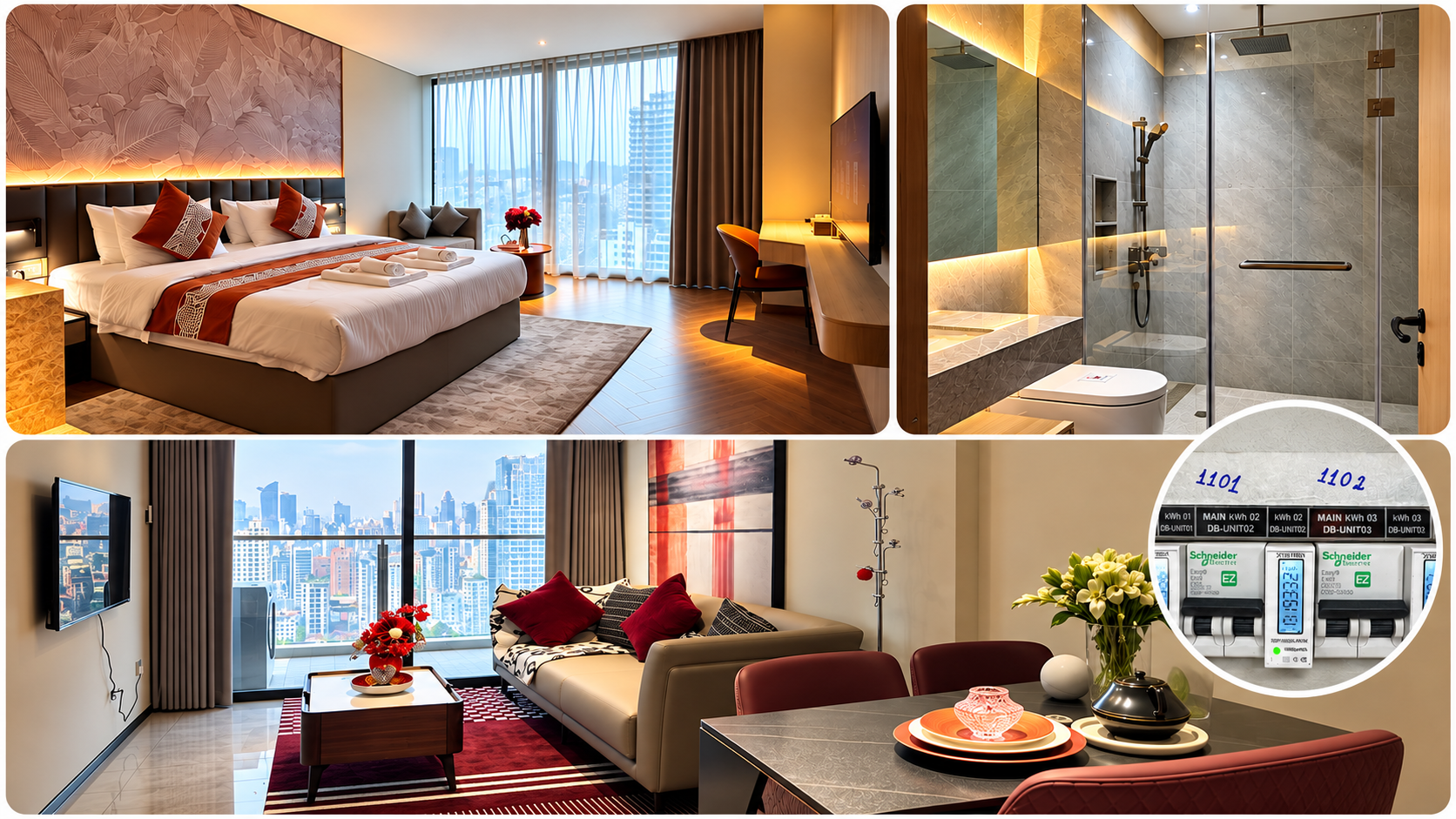
Finding an apartment in Phnom Penh is relatively easy. Finding one that is genuinely comfortable to live in — without unpleasant surprises after moving in — is a different challenge.
A modern condominium, an attractive swimming pool, a spacious living room and a tempting rental price can all look convincing. But after moving in, you may discover construction noise next door, an air conditioner that rattles, leaks or barely cools the room, weak water pressure, or additional charges you had not anticipated.
These problems can be particularly difficult to assess for foreigners who are planning a move to Cambodia and do not yet know the local rental market.
In this guide, I share 10 apartment-renting mistakes in Phnom Penh, in the order I consider most important based on my personal experience. At the end, you will find a free interactive 25-point inspection checklist you can use during a viewing.
Jump to the Free Inspection Checklist ↓
1. Choosing the Wrong Neighborhood
In my view, one of the biggest mistakes is choosing an apartment without getting to know the surrounding neighborhood first.
Phnom Penh is a city of contrasts. Even two neighboring streets can feel completely different. One might be lined with international restaurants, supermarkets and modern condominiums; the next may have traditional markets, heavy traffic and a much more local atmosphere.
No single area is ideal for every foreign resident. Consider these examples:
-
BKK1 attracts people looking for international restaurants, cafés and a central location.
-
Tonle Bassac offers modern condominiums, commercial facilities and convenient access to central Phnom Penh.
-
Toul Tom Poung has a distinctive neighborhood atmosphere, local markets, cafés and a variety of housing options.
-
Riverside and Daun Penh may suit those who enjoy a busy central setting and proximity to the riverfront.
-
Toul Kork may appeal to people looking for residential areas away from the busiest tourist districts.
-
Chroy Changvar is worth considering if you value peace and a slower pace of life — although individual streets can still be affected by traffic or construction.
My advice: before searching for a particular apartment, think about where you will spend most of your time. Visit the neighborhood during the day and in the evening. Check grocery shops, transport routes, walking conditions and other practical amenities.
A beautiful apartment in the wrong location soon loses its appeal.
2. Choosing an Apartment Based Only on Photos
Professional photographs can make almost any property look impressive.
Wide-angle lenses make rooms appear larger, carefully chosen lighting conceals flaws, and photos of the pool or gym can create the impression that the entire building is in perfect condition.
But pictures do not reveal unpleasant smells, dampness, air-conditioner problems or noise outside the windows. They may also have been taken years ago.
My advice: ask for recent photos and a video of the exact unit being offered, rather than a similar apartment in the same building.
Request views of the kitchen, bathroom, windows, balcony, air conditioners and neighboring buildings.
Whenever possible, arrange an in-person viewing or an independent inspection.
3. Ignoring Noise and Nearby Construction
Phnom Penh continues to develop, so nearby building work deserves serious attention.
A lovely city view may become less attractive if construction begins next door. Road traffic, bars, workshops and music can also affect your quality of life — especially if you work from home.
What Should You Look For?
Check the land and buildings around the property.
Are there vacant plots, fenced sites or construction projects in progress? Is the apartment near a busy road, bar or workshop?
If possible, visit at different times of day yourself, or ask the agent to do so.
My advice: during the viewing, open the windows if possible and simply listen to the surroundings for a few minutes.
A quiet afternoon viewing does not guarantee quiet mornings or evenings.
4. Failing to Document the Apartment's Current Condition
Many tenants only appreciate this mistake when it is time to move out.
Imagine that, a year later, the owner points to a scratch on the furniture, damage to a wall or a faulty appliance. Was the problem already there when you moved in?
Without reliable evidence, resolving a disagreement can be difficult.
Photos and videos matter both during the initial inspection and when the keys are handed over.
What Should Be Documented?
Record the walls, floors, ceilings, doors, windows, plumbing, furniture and appliances.
Photograph any existing scratches, cracks, stains and other defects.
Note the utility meter readings and prepare an inventory of the property.
Ideally, photos and videos should be dated, and the landlord or an authorized representative should acknowledge the condition report in writing.
My advice: keep the original files for your entire tenancy.
They may be valuable when discussing your security deposit at move-out.
5. Overlooking Early Termination Terms
Suppose you sign a 12-month lease but decide after four months to move to another neighborhood or leave Cambodia.
What happens to your deposit? Can you end the agreement early? How much notice must you give? Are there penalties?
You need answers before signing.
Rental agreements with terms beginning around six months can be found, while many landlords prefer a one-year commitment.
The actual minimum depends on the property and the agreement; it is not a universal legal rule.
Check the Following
-
The total lease term and minimum commitment.
-
Required notice for ending or renewing the lease.
-
Early termination penalties, including possible forfeiture of the deposit.
-
Whether a mutually agreed early termination is possible.
Negotiation Is Normal in Cambodia
It is perfectly reasonable to negotiate rental terms.
This can include not just the monthly rent but also the deposit, lease duration, early termination provisions, repairs or replacement furniture, and which services are included.
Of course, not every landlord will agree to every request.
My advice: if you are unsure whether you will stay for a full year, discuss flexibility before signing and put all agreed changes in writing.
6. Forgetting About Utility and Service Charges
An attractive rent does not automatically mean a low monthly housing cost.
Electricity, water, internet, waste collection, parking and building maintenance fees may be charged separately.
Electricity deserves particular attention.
Air conditioners are used frequently in the tropical climate, so power can be a significant expense.
How Much Does Electricity Cost?
Some Phnom Penh condominiums charge US$0.25 per kWh or more; rates around US$0.30–0.35 per kWh are also encountered.
Other properties may charge less. These are illustrative building-level tariffs, not a universal electricity rate.
For example, if your apartment uses 400 kWh in a month, the electricity bill would be approximately:
-
$100 at $0.25/kWh.
-
$120 at $0.30/kWh.
-
$140 at $0.35/kWh.
The difference is $40 per month, or $480 per year, for the same usage.
Questions to Ask
What is the price per kilowatt-hour? Who issues the bill? Is there a separate meter? Which charges are included in the rent?
Ask to see a recent bill if one is available.
My advice: compare the total expected monthly housing cost, not just the advertised rent.
7. Not Testing the Air Conditioners, Water Pressure and Inventory
An apartment can look modern and still have important technical problems.
It is not enough to see that the air conditioner switches on.
Check that it actually cools the room, does not make excessive noise, has no unpleasant odor and is not dripping water.
Likewise, a beautiful shower tells you nothing about water pressure or whether the water heater functions properly.
Practical Checks
Switch on the air conditioners and let them run for a while.
Open the taps, test the shower and toilet flush, inspect accessible areas beneath the sinks, and check the lights and accessible power outlets.
For a furnished apartment, compare the actual contents with the inventory:
-
Bed and mattress.
-
Sofa.
-
Tables and chairs.
-
Refrigerator.
-
Washing machine.
-
Air conditioners.
-
Other listed furniture and appliances.
Inspect their condition, not just their presence.
My advice: a verbal promise that "we'll fix it later" is not the same as a completed repair.
Agree on the work and deadline before moving in, preferably in writing.
8. Signing Without Checking the Deposit Conditions
Rental listings in Phnom Penh commonly request a deposit equivalent to one or two months' rent, although actual arrangements vary.
The important question is not only how much you pay, but under what circumstances you get the money back.
A lease may allow deductions for damage, unpaid bills or failure to meet contract terms.
Clarify the difference between damage and normal wear and tear.
Your Lease Should Make These Points Clear
-
The exact deposit amount and recipient.
-
How and when it should be returned.
-
Permitted deductions and how they are documented.
-
Whether a joint move-out inspection is required.
-
How the final utility bills are settled.
Take the Written Agreement Seriously
In my experience, it is wise to treat the written terms of a Phnom Penh rental agreement seriously.
Do not assume that an unfavorable condition can easily be renegotiated after you sign.
Agreed discounts, repairs, deposit terms and other promises should be included in the written contract.
FPCS: Registering a Foreign Tenant's Address
Cambodia uses the Foreigners Present in Cambodia System (FPCS) to record foreign nationals staying at a particular address.
The landlord or accommodation manager is generally responsible for reporting the foreign guest or tenant.
If you plan to stay long term, ask before signing whether the landlord will complete the FPCS registration.
After moving in, request confirmation that your details and actual address have been recorded correctly.
Missing or incorrect FPCS records may cause difficulties with extensions of stay.
FPCS is an address reporting system; it does not replace a visa or grant permission to remain in Cambodia.
My advice: coordinate the registration with the landlord early instead of waiting until you need to renew your immigration status.
9. Paying a Deposit or Advance Too Quickly
Desirable apartments may be rented quickly, and prospective tenants sometimes hear: "Transfer the money now or someone else will take it tomorrow."
Do not let that pressure replace basic checks — especially if you have not seen the property or verified the person receiving the funds.
Before Transferring Money, Confirm
-
The property exists and the exact unit is available.
-
The landlord's identity or the agent's authority to collect payment.
-
What the payment is for and whether it counts toward rent or deposit.
-
Under what conditions it can be refunded.
-
What receipt or other proof of payment you will receive.
Keep receipts, transfer confirmations and written correspondence.
My advice: do not send money simply because someone is rushing you.
First make sure you understand the property, payee, payment purpose and terms.
10. Renting Remotely Without an Independent Inspection
This final mistake is especially relevant to people still living in Europe, the United States or elsewhere abroad.
It makes sense to organize a move in advance, but the gap between attractive listing photos and the actual condition of a property can be considerable.
A video supplied by the landlord or listing agent is useful, but it may not answer every question a future tenant has.
What Can Be Checked Remotely?
A local representative can visit the exact apartment, take recent photos and videos, perform basic visible checks of the air conditioning and plumbing, inspect the furniture and report on the surroundings.
A general visual inspection is not a substitute for a specialist building survey or legal review of the tenancy agreement.
My advice: if you cannot visit in person, avoid committing funds solely on the basis of marketing materials.
An independent inspection before signing can be much more valuable than trying to resolve problems after moving in.
How Qunera Services Can Help You Rent an Apartment
Choosing an apartment is not just about finding an attractive price.
It is about confirming that the property suits your needs and understanding the rental terms before paying.
Qunera Services is based in Phnom Penh and offers practical local assistance for foreigners who are relocating to Cambodia or already live here.
Apartment Search
Assistance finding suitable options based on budget, preferred area, infrastructure and practical requirements.
Property Inspection
On-site visual inspections with current photographs and video, checking accessible systems, inventory and the general condition of an apartment.
Relocation Assistance
Help arranging viewings, coordinating practical communication, preparing for arrival and getting settled.
If you would rather not rent sight unseen, contact Qunera Services for local help.
WhatsApp: https://wa.me/855767776732
Website: https://qunera.online/en
Frequently Asked Questions
Should I Inspect an Apartment in Person Before Renting in Phnom Penh?
Whenever possible, yes. If you cannot visit, an independent inspection with recent photos and videos can help you assess the property.
How Much Is a Typical Rental Deposit?
Deposits equivalent to one or two months' rent are commonly encountered, but amounts and refund terms vary. Read the particular lease carefully.
Can I End a Lease Before It Expires?
Check the early termination clause, required notice and any financial penalties in your specific contract before signing.
Are Utility Bills Always Included in the Rent?
No. Electricity, water, internet, parking and building service charges may be billed separately.
Can I Negotiate the Rent or Lease Terms?
Yes. Rent, deposit, repairs and other conditions can be discussed. Make sure that any agreed changes appear in the signed contract.
Why Should I Photograph the Apartment on Move-In Day?
Dated photos and videos help document the original condition of the apartment, furniture and appliances, which can be useful when discussing damage and the return of the deposit.
What Is FPCS, and Why Does It Matter?
FPCS (Foreigners Present in Cambodia System) records where foreign visitors and residents stay in Cambodia.
Ask your landlord or building manager to register you at the correct address and provide confirmation.
FPCS does not replace a valid visa or extension of stay.
Can I Rely on Apartment Listing Photos?
Photos are a useful starting point but may be outdated or omit problems.
Recent images and an actual inspection provide a more reliable basis for a decision.
Phnom Penh Apartment Inspection Checklist
25 checks before renting and at handover. Record your findings and print your inspection report.
Select a result for each item. Add a comment if you find a problem. Complete the handover section when collecting the keys or moving in.
This checklist is for preliminary inspection only and does not replace a professional technical assessment or legal advice. Your entries remain on the page until you refresh or close the tab; print or save as PDF to keep a copy. FPCS registration does not replace a visa.
Sources and Further Reading
AG Cambodia — Renting a Home in Phnom Penh
https://www.agcambodia.com/renting-a-home-in-phnom-penh-what-tenants-and-landlords-should-know/
APS Cambodia — How to Rent a Property in Phnom Penh
https://aps.com.kh/how-to-rent-a-property-in-phnom-penh/
Expat Start Cambodia — Finding and Renting an Apartment in Cambodia
https://expatstartcambodia.com/finding-and-renting-an-apartment-in-cambodia/
Last updated: October 2026.
Disclaimer: This article is for general information and practical guidance only. Your tenancy is governed by its specific terms and applicable law. Consult a qualified professional for legal advice or a specialized technical assessment.